23.06.2026

Quick service restaurants (QSRs) depend on accurately purchasing, storing, and managing hundreds of inventory items each day to meet customer demand. Consider the typical QSR meal below: at first glance, the number of products appears minimal, but preparing this single meal requires at least 16 individual inventory items to be in stock and available at the right time.
Adding complexity to the forecasts, QSRs also have limitations in storage space, the perishability of many ingredients, and many products share common components. For example, double and single cheeseburgers, and even the chicken sandwiches may all share the same type of bun, creating hierarchical dependencies that make forecasting significantly more challenging. A shortage of even a single component can impact the availability of numerous menu items, disrupting operations, reducing sales opportunities, and negatively affecting the customer experience. The challenge becomes even more complex when considering that many inventory items are forecasted and managed at the distribution center level, requiring demand to be accurately aggregated across stores, regions, products, and time horizons.
Elder Research engaged with one of our trusted clients that wanted to design an effective and efficient supply chain forecasting model to ensure that its network (i.e., the client’s ability to impact and manage capacity across many processes, locations, and people across the end-to-end supply chain) could efficiently meet store demand without overburdening any distribution center.
Supply chain networks are planned years in advance and must be robust enough to handle growth and attrition at existing stores while balancing the future openings of new stores. To facilitate this planning, our client needed accurate long-term demand forecasts for inventory items across each of its thousands of locations, totaling more than a million individual forecasts. Demand for inventory items is incredibly varied and heterogeneous. Some non-perishable items like napkins can be ordered in bulk once per quarter while other items with shorter shelf lives require delivery of hundreds of cases each month. This type of analysis required innovative approaches, including robust confidence intervals, while balancing the nuances and dynamics of this organization’s supply chain network.
Elder Research teamed with our client leveraging a robust Agile Data Science process. Our team methodically engaged customer and stakeholder needs with best-in-class data science methods with deployment and change management requirements. The result is that our data science team built two custom Long Short Term Memory (LSTM) forecast models with different time horizons to predict future usage of each inventory item at each restaurant. Candidate models ranged from established time series methodologies (e.g., ARIMA, exponential smoothing) to more sophisticated techniques (e.g., Facebook’s prophet, Amazon’s DeepAR). Two primary considerations were used to evaluate alternatives: accuracy and computational feasibility.
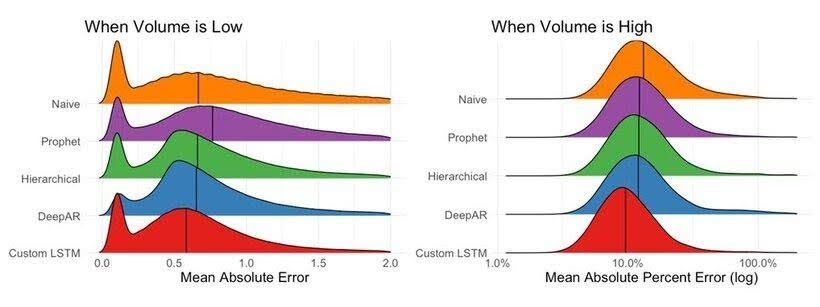
Our custom LSTM model outperformed the other methodologies when tested using historical inventory item volume, thus giving our client a more accurate perspective on future demand. For example, shown below are distributions of mean absolute errors for low volume items and mean absolute percent errors for high volume items (where that metric is more appropriate). The median of each distribution is marked by a vertical bar.
By using GPU-enabled cloud computing, one LSTM model generated predictions for every item, location, and time period in the same amount of time and cost compared to “simpler” techniques that require separate models for each item/location combination. A second LSTM model with a longer forecast time horizon extended how far into the future the client can plan.
Our LSTM model and DeepAR were the only techniques that could natively forecast future store openings. But unlike DeepAR, which is offered by AWS as a prepackaged solution, Elder Research delivered and handed-off the custom LSTM model code and its intellectual property rights to our client. Because the models are fully client owned, they can be:
Additionally, to quantify the confidence of each forecast, we employed Monte Carlo simulations using dropout to simulate future monthly demand for each item and location. The use of simulations enables efficient calculation of confidence intervals at any level of aggregation across the location and item hierarchy, thus allowing the client to understand future uncertainty around distribution center level volume and view their supply chain at multiple levels of detail to make informed, risk-conscious decisions.
Prior to partnering with Elder Research, the client’s supply chain analysts leaned on less precise forecasts and rules of thumb to make their network analysis and planning decisions. Now, with the state-of-the-art LSTM model we deployed, analysts and non-technical stakeholders have an interactive dashboard with which to explore the latest—more accurate—forecasts, and even evaluate hypothetical DC allocations. With this knowledge, our client can make more informed decisions on planning and allocation, ultimately saving them a tremendous amount of time and money.